Wednesday, 8 October 2014

A visit to Dorset

An insider's look

Bridport 


Visiting a foreign country is always exciting.  One experiences everything with heightened senses and remembers what takes place vividly.  Something that adds immeasurably to this is if friends or family show you around.  We were treated with the greatest kindness and hospitality by our friends Kevin and Madeleine Lomas and their family.  

They picked us up in Cardiff and we drove off to Bridport, where Madeleine's parents live.  Dorset is still quite rural, so we could start relaxing and enjoying the surrounding countryside right away.  

Our first stop was at Clevedon where we had a bit of a picnic. 


From the beach one can see all the way across to Cardiff where we came from.


From there we visited Cheddar, presumably this is where the specific variety of cheese has its name from.  We had a quick look at the Cheddar gorge - we really have to go back for a longer visit - it is extraordinary.


We stopped in Cheddar for a cup of tea.  The photo shows Madeleine in front with Kevin hidden behind her. 


From there we went to Madeleine's sister's home.  She, Debbie Smith, and her husband, John Dalton, live on a smallholding outside Bridport.


They did a lot of renovation themselves and the end result is truly picturesque.


If one visits England in spring one sees many little lambs and I still have to meet the young lady that does not immediately want one of her own. Debbie got herself two of those, but like everybody warns, they very quickly become fully grown sheep. Luckily she could keep them.


 Debbie and John own a poli tunnel, for growing vegetables, but this has become a very pleasant outside entertainment area.


This is Debbie picking us some vegetables which we had for supper later the same evening.  They manage to have a very green lifestyle.


Kevin knew exactly where the best spot was - well he had done all the driving.


Madeleine's parents, Pete and Hilda Smith, sat on the couch.


It was really pleasant in the tunnel. The tea made it even more so.  Here Pieter Botha, my husband, and John are sharing a joke.


John and Debbie are just very good at crafts and not afraid to work very hard.  This is even more evident inside their home.


The kitchen was really special with lots of attention to small details. The dining room table is of cedar wood, bought locally.  John made it himself. Debbie served us a good, much appreciated meal.

We are most privileged to have such friends.


Tuesday, 16 September 2014

Cardiff, UK in May 2014

Cardiff, UK in May


We left Norway from Stavanger Airport.  It was fairly clear so we could see the Thames from the aeroplane as we started descending towards Heathrow.  If you are not a EU citizen you are not allowed to fly directly to one of the smaller airports like, Cardiff.


From Heathrow we went to Cardiff by bus. There we visited Cardiff Castle at the very first opportunity.  The castle is really impressive and is busy with tourists, soldiers giving demonstrations and school children - a real community centre.  We are taken by surprise by the number of people using Welsh.  Welsh is even still used at the university like Pieter Botha, my husband discovered at the conference there.
The castle wall with the tower at the front entrance


Cardiff used to be part of the territory of a Celtic British tribe.  A fort was established by the Romans here in the year 75. Parts of the old wall can still be seen as marked by the coloured bricks on the outside wall and as part of the museum inside.  In 1081 the castle keep was built by William I, King of England, inside the old Roman fort.


Pieter and I against the wall of the keep


The third Marquess of Bute substantially changed and extended the castle.  It is because he and his family had to spend a week or two every year at the castle that we now have an amazingly richly decorated interior to admire.  He was said to have been the richest man of his time.

The library, much admired by Pieter, as can be seen below.


The river Taff flows by the castle and it is by river that we travelled to Cardiff Bay.


We floated past the Millennium Stadium, where the Springboks still come to compete against Wales.

One can see flags displaying  the Red Dragon of Wales in the streets

This picture is taken with the castle in the foreground and the Millennium Centre (rugby stadium) behind it. Notice the contrast between old and modern again.

The scene is tranquil from the water


The riverboat took us right to Cardiff Bay, which still is a major port for the transport of coal. 


The golden bow is part of the roof of the Millenium Centre (Culture) and the red brick building in front used to be the building used for the export of coal.
In the bay we noticed a party in full swing on a military cruiser

Who said a lighthouse had to be stationary?


We loved the use of sculpture again.  Is this a ship that has run aground?


Of course, all this travelling creates a pile of laundry.  We discovered a laundromat which several athletes and rugby players also had to use during their stay.  This is really an efficient way of dealing with that part of everyday life.


Luckily the hotel provided ironing facilities


At the hotel, we were picked up by our good friends, Kevin and Madeleine Lomas.  Thanks to them we could from there explore the South of England.


Thursday, 28 August 2014

Lysefjord


As jy baie gelukkig is het jy 'n huis langs die fjord.  Jy sou dit moes geërf het, want vandag is so 'n eiendom onbetaalbaar duur.

Dis nou 'n fjord

Een van ons hoof doelstellings, behalwe nou die kongres, was om in Noorweë die fjords te gaan bewonder. Ons is met die Hurtigruten van Trondheim af na Bergen al met die fjords langs, maar die fjord soos vaagweg uit definisies onthou het ons bly ontwyk.  Ons het gesoek vir steil afgronde en intimiderende berghange met sneeu en ys wat oor alles lê.  Ons het nie verwag dat dit soos in 'n groot dam is omring met heuwels en berge nie.  

Die fjord wat uiteindelik 'n hoogtepunt was is die Lysefjord.  Hierdie 42 km lange fjord waar die see die gleuwe van ou gletser opgevul het is lank en smal en die berghange om die water so onherbergsaam dat mens net met 'n boot by jou blyplek kan uitkom. 

Ons is daarlangs met 'n bootuitstappie vanaf Stavanger.  Rebecca Solevåg, van die MHS, het ons saam genooi - wat 'n ongelooflike voorreg.


So het die boot gelê en wag.

Die fjord lê oop voor ons.

Reg langs die loodregte kranse.
Hier is Rebecca in die middel met Julia Watts Belser op die rolstoel langs haar.

 Op die dek.
Ons vaar verby pragtige rotsformasies.
Teen 'n hang is daar 'n paar bergbokke.

Is dit 'n rob of 'n otter?  

Hierdie bergwater is suiwer.  Ons het almal 'n bietjie daarvan te drinke gekry.

Die "Preikestolen". Dit is 604m die lug in op en die fjord is blykbaar hier net so diep ook.  'n Aanbevole uitstappie is om met die berg op te loop tot by die Preikestolen.  Jy hoef net oor 'n klein skeur te stap om daar uit te kom.  Ek kan nie dink hoekom ons toe maar besluit het om nie oor die afgrond te gaan tree nie.

Nog 'n krans.  "Base jumping" word oral hier toegelaat.


Wednesday, 27 August 2014

Die Noorweegse Oliemuseum

Die Oliemuseum in Noorweë

Iets wat ons ongewoon baie plesier verskaf het, was die oliemuseum in Stavanger.  Die Noorweërs waarmee ons gesels het vermy die plek en wil liewer fokus op 'n groen lewensstyl.  Feit is 200 000 mense werk in die oliebedryf en die hele land beleef duidelik 'n bloeitydperk wat 'n mens eintlik nie anders kan as om met die ontgunning van olie uit die Noordsee sedert die 1970's te verbind nie.

'n Mens kan ook nie anders as om die manier hoe die fonds bestuur word te bewonder nie.  Die regering het die maatskappy Statoil begin, waarvan Noorweërs die aandeelhouers is, maar die inkomste uit die olie word belê en slegs die opbrengs op die beleggings word gebruik.  Die infrastruktuur wat betref paaie, brûe, tonnels, vervoer, hospitale en skole is opmerklik goed.  Groot dele van die onherbergsame, pragtige land is nou baie meer bereikbaar.  

Die oliefonds word beskou as iets wat bestuur moet word vir die komende geslagte.  Die fonds is reeds meer as 2000 biljoen NOK (Noorweegse krone) sterk, of so ongeveer 500 000 krone vir elke burger. In die museum is dit duidelik dat daar steeds 'n  openbare debat is of elke burger nie maar net hulle geld kan kry nie.

Nou weet julle wat my die meeste beïndruk het, Pieter het weer die tegnologie agter olieplatforms en oliebore baie geniet.  

Die museum se argitektuur is besonders, dit lyk soos 'n klein olieplatform


Hierdie is een van die inligtingsborde in die museum

Hierdie is 'n getroue model van 'n olieplatform, uit die dae voordat mens alles op 'n rekenaar kon beplan.  Die Noorweërs het sonder moeite van bootbou na die bou van olieplatforms uitgebrei.


'n Mens kan in 'n klein duikvaartuig klim om te sien waarmee die oliewerkers diep genoeg kom om die toerusting te gaan nasien.

Deel van die museum is 'n klein olieplatform. Hier is die boonste deel van die olieboor.


Hierdie is 'n beheerkamer van vanmelee vir 'n olieplatform.


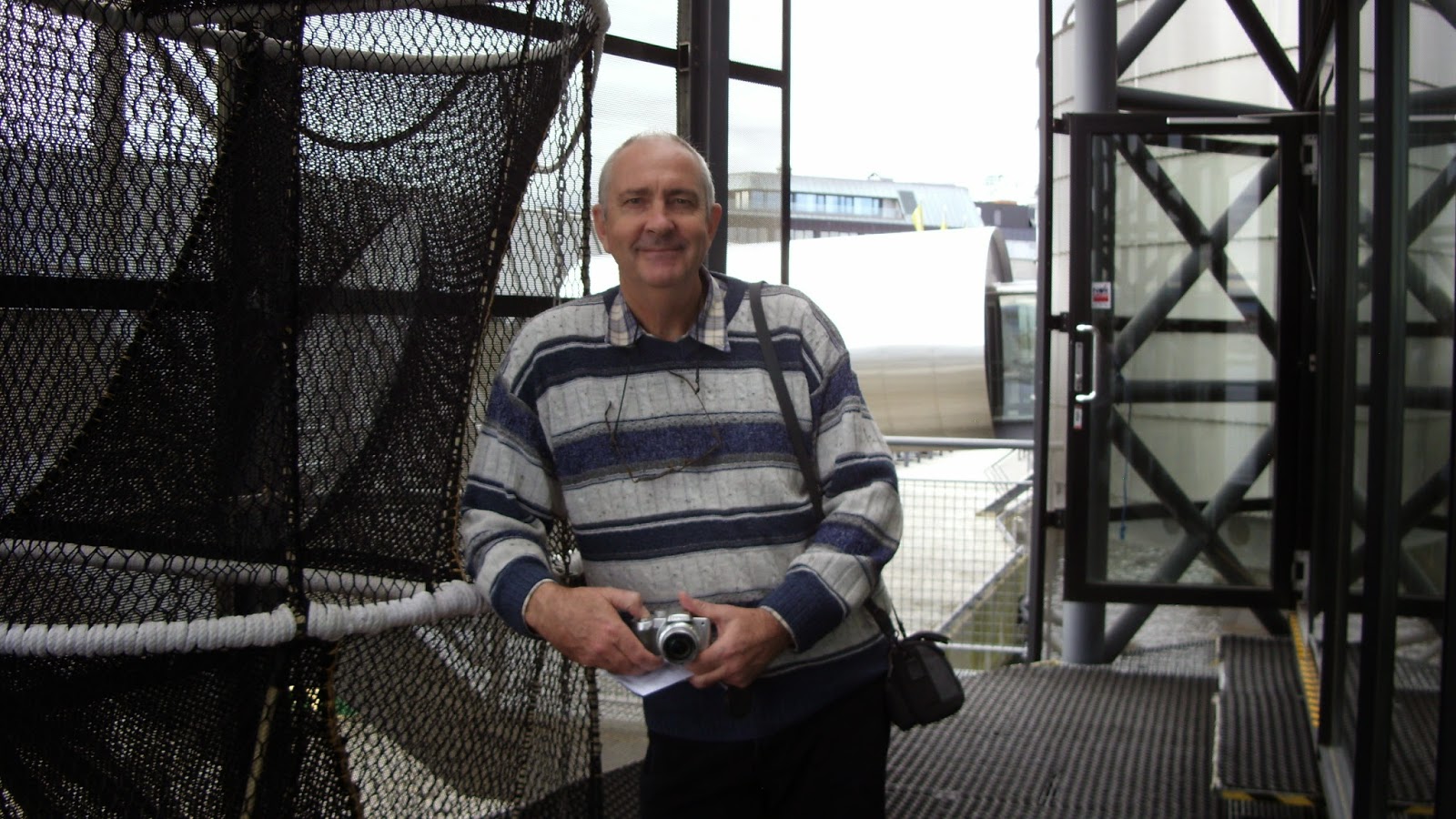
Hier was Pieter, soos hy self gesê het, sommer baie gelukkig.


/'n Beheerstoel vandag.


Pieter Botha op die klein olieplatform.